

Carregue numa fotografia para ir para os Livros Google.
|
A carregar... Watership Down (1972)por Richard Adams
  
Best Fantasy Novels (36) » 103 mais Five star books (3) 1970s (1) Favourite Books (148) BBC Big Read (55) Favorite Long Books (43) Ambleside Books (33) Books Read in 2019 (116) BBC Big Read (42) Carole's List (68) CCE 1000 Good Books List (119) Books Read in 2023 (327) Top Five Books of 2016 (225) Top Five Books of 2023 (225) Books Read in 2016 (1,110) Overdue Podcast (52) Comfort Reads (95) Books Read in 2014 (503) Epic Fiction (23) First Novels (37) Books Read in 2015 (1,601) BBC Top Books (1) Fake Top 100 Fiction (18) Read These Too (24) the dog was the hero (23) discontinued (8) Book wishlist (1) Story Within a Story (35) um actually (54) Evan's Wish List (85) Books tagged unread (14) Unread books (810)
 deborahee | Feb 23, 2024 | deborahee | Feb 23, 2024 |    ) bschweiger | Feb 4, 2024 | ) bschweiger | Feb 4, 2024 | Awards: Mythopoeic Fantasy Award Nominee (1975), Guardian Children's Fiction Prize (1973), Audie Award Nominee for Best Male Narrator (2020), Boston Globe-Horn Book Award (1975), California Young Readers Medal for Young Adult (1977), Carnegie Medal (1972) isabelcleveland | Dec 6, 2023 | This classic tale has something relatable for everyone. While yes the characters are rabbits, the overall tale is one that can easily be applied to people as far as a tale of survival and perseverance. The story shows the resilience and determination. Sensing danger a brave group dares to set out and build a new home. Just as many refugees, the rabbits have their struggles yet their legends and myths help guide them and by sticking together they succeed. There are lessons throughout this book that can teach us all something. (  ) TiffanyCutshall | Dec 3, 2023 | FKarr | Nov 29, 2023 | ) TiffanyCutshall | Dec 3, 2023 | FKarr | Nov 29, 2023 |
 Watership Down offers little to build a literary cult upon. On the American-whimsy exchange, one Tolkien hobbit should still be worth a dozen talking rabbits.  This bunny-rabbit novel not only steers mostly clear of the usual sticky, anthropomorphic pitfalls of your common garden-variety of bunny rabbit story: it is also quite marvelous for a while, and after it stops being marvelous, it settles down to be pretty good- a book you can live with from start to finish.  It simply isn't possible. At this date, you cannot write a story about rabbits, 413 pages long, and hold a reader riveted. But Richard Adams has done exactly that in Watership Down (Rex Collings, £3.50). This is a great book, establishing a more than plausible and totally fascinating psychology and physiology for its rabbits, together with their own mythology and language. It sounds formidable, perhaps; yet what one's aware of, reading, is a story of the most exciting kind, remaining taut over all those pages. It's set in a precise part of Berkshire (map provided) – the hejira of a group of rabbits who accept a clairvoyant companion’s prophecy that their warren will be destroyed; their establishment of a new home and their search for mates – this leading to war with a warren ruled by the protectively totalitarian General Woundwort. A whole world is created, perfectly real in itself, yet constituting a deep incidental comment on human affairs. Pertence a SérieWatership Down (1) Está contido emTem a adaptaçãoInspiradaTem um guia de estudo para estudantesPrémiosDistinctionsNotable Lists
Classic Literature.
Fantasy.
Young Adult Fiction.
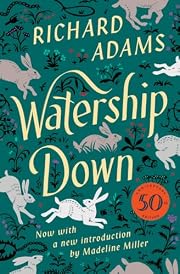
HTML: Fiver could sense danger. Something terrible was going to happen to the warren; he felt sure of it. They had to leave immediately. So begins a long and perilous journey of survival for a small band of rabbits. As the rabbits skirt danger at every turn, we become acquainted with the band, its humorous characters and its compelling culture, complete with its own folk history and mythos. Fiver's vision finally leads them to Watership Down, an upland meadow. But here they face their most difficult challenges of all. A stirring epic of courage and survival against the odds, Watership Down has become a beloved classic for all ages. Both an exciting adventure story and an involving allegory about freedom, ethics, and human nature, it has delighted generations with its unique and charming world, winning many awards and being adapted to film, television, and theater. .Não foram encontradas descrições de bibliotecas. |
Capas populares
 Google Books — A carregar... Google Books — A carregar...GénerosSistema Decimal de Melvil (DDC)823.914Literature English & Old English literatures English fiction Modern Period 1901-1999 1945-1999Classificação da Biblioteca do Congresso dos EUA (LCC)AvaliaçãoMédia: (4.21)
É você?Torne-se num Autor LibraryThing. |
||||||||||||||||||||||||||||||||||||||||||||||||||||||||||||||||||||||||||||||||||||||||||||||||||||||||||||||||||||||||||||||||||||||||||||||||||||||||


 Watership Down


 6
6
I read the author's forward and particularly took liking to the fact that he said that "Watership Down was never intended to be some sort of allegory or parable. It is simply the story about rabbits made up and told in the car." The fact that Adams wrote this for the purpose of entertaining his children and not providing some big, hidden narrative just really makes me like this book even more.
Without a doubt I'll be buying my own copy of this and rereading it in the future.
(Also I just want to be honest and say I literally cried like three times while reading this. Yeah, I'm a woman in my twenties crying over fictional rabbits. It be like that sometimes. ¯_(ツ)_/¯ ) (